

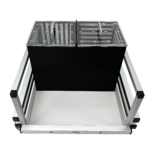

Novel Object Base
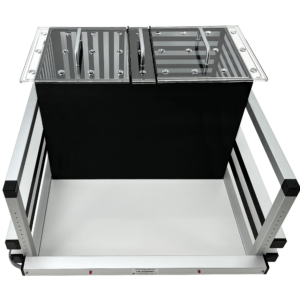
The Novel Object Base for the SuperFlex open field system allows researchers to conduct automated novel object recognition studies. It features magnetic podiums to securely position objects without interfering with locomotor tracking. Objects can be attached using various methods like zip-ties or Velcro. Vertical sensors track when animals interact with the objects, and the Fusion software’s Zone Designer enables automated tracking by drawing zones around the objects. Data can be exported to analyze locomotor activity and object interaction within specific zones.
The Novel Object Base is designed to seamlessly integrate with the SuperFlex open field, enabling researchers to conduct automated novel object recognition task studies with precision. Low-profile magnetic object podiums (stand-offs) are included, allowing objects to be securely positioned at various evenly distributed locations throughout the open field.
These locations are strategically placed between the infrared beams to ensure uninterrupted locomotor tracking.
Objects can be attached to the magnetic podiums using zip-ties, Velcro, or double-sided tape, depending on the object’s size and the desired level of interchangeability.
Vertical sensors, when positioned above the objects, can be used independently to detect if or when the subject climbs on the object.
The Zone Designer within the Fusion software streamlines the automation of the novel object task. Researchers can simply draw corresponding zones around each object within the open field. An additional zone can also be created to cover any unoccupied space, if needed. Once the experiment is complete and data is ready for export, selecting “Zone Export” from the Export Experiment dialogue provides detailed locomotor activity data for each individual zone.
Related products
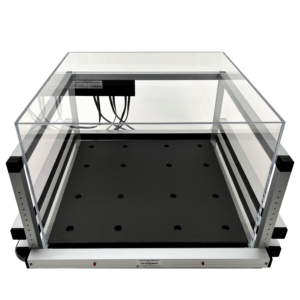
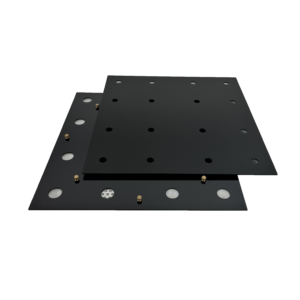
Baited Hole Board
This system features an elevated platform with 16 equally spaced holes, each large enough for an animal to investigate without passing through. Beneath each hole is a food or reward cup, some of which are covered by removable screens, allowing the animal to see and smell the reward without retrieving it. Light beam sensors monitor which holes the animal investigates, tracking the time, duration, and location. Over time, animals typically make fewer mistakes and reach the target holes faster, allowing researchers to measure learning and behavior.
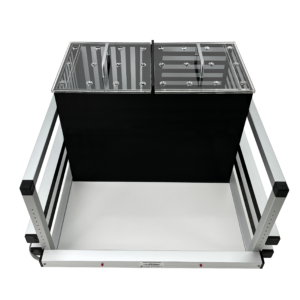
Conditioned Place Preference
The Conditioned Place Preference (CPP) and Conditioned Place Aversion (CPA) systems are used to study animals' preference or aversion to stimuli, such as drugs, through Pavlovian conditioning. The protocol consists of three phases: habituation, conditioning (associating the drug with a cue), and testing where the animal chooses between the drug-associated and neutral cues. If the drug induces preference, the animal spends more time near the drug cue, or less time if it induces aversion. Sensors track variables like locomotor activity, time spent, entries into compartments, and movement, providing detailed data on the animal's response to the conditioning.